Home Water Storage for Emergencies: How Much You Need and How to Do It Right
Water is the first thing that runs out in any emergency. After a hurricane, earthquake, severe ice storm, or water main break, your tap may run dry or become unsafe for days. Sometimes weeks. Grocery store shelves empty within a few hours of a disaster warning. The bottled water section goes first every time.
The good news is that storing water at home is one of the simplest and least expensive things you can do to protect your family. You do not need a giant underground tank or a bunker. You need a plan, the right containers, and a little space. This guide walks you through everything from figuring out how much water your household needs to choosing the right containers, treating and rotating your supply, and solving the space puzzle if you live in an apartment.
Why Trust This Guide?
This article was researched and reviewed by contributors with hands-on experience in emergency preparedness. They have tested gear, built real systems, and lived through situations where these skills actually mattered.



How Much Water Does Your Household Actually Need?
The rule you will see from FEMA and the Red Cross is simple: one gallon of water per person per day. That is the survival minimum. It covers drinking water and very basic hygiene like hand washing and brushing teeth.
But one gallon is tight. In real emergencies, most people find they need more. Cooking, rinsing, basic cleaning, and caring for babies or pets all add up quickly. A more comfortable target is 1.5 gallons per person per day.
Here is what a realistic daily breakdown looks like at the one-gallon-per-day minimum:
- Drinking: 0.5 gallons (about 64 ounces)
- Hand washing: 0.2 gallons
- Teeth brushing: 0.05 gallons
- Basic food prep and cooking: 0.25 gallons
That adds up fast. And it does not include flushing toilets, bathing, or laundry.
Special Circumstances That Require More Water
Some situations push your needs well above the standard recommendation:
Hot climates and summer heat. If temperatures are above 90 degrees Fahrenheit, you sweat more and need more water to stay hydrated. Add at least 0.5 extra gallons per person per day.
Physical exertion. Clearing debris after a storm, hiking to safety, or doing physical labor during a crisis burns more water. Plan for extra.
Infants and young children. Formula preparation, bottle washing, and hygiene for babies requires more water than caring for older kids or adults.
Medical conditions. Some medications and health conditions increase fluid needs. If anyone in your household is on dialysis, has kidney issues, or takes medications that require extra hydration, consult their doctor for guidance.
Pets. Dogs and cats need water too. A large dog can drink a gallon or more per day in hot weather. A typical household cat needs about 0.1 gallons daily.
Nursing mothers. Breastfeeding increases fluid needs by about 0.4 extra gallons per day.
The practical advice: plan for the minimum (1 gallon per person per day) as your floor, and aim for 1.5 gallons if you have the storage space. Build in extra for pets and special circumstances.
How Long Should Your Supply Last?
FEMA recommends a minimum 3-day supply for most emergencies. But many preparedness experts and real-world disasters suggest that two weeks to one month is more realistic. During Hurricane Katrina, some areas were without safe water for weeks. The Texas winter storm of 2021 left millions without water for over a week.
Two weeks is a solid target for most households. One month is excellent.
Choosing the Right Water Storage Containers
Not all containers are safe for water storage. Using the wrong ones can leach chemicals into your water or allow bacteria to grow. Here is what you need to know.
What Makes a Container Food-Grade?
A food-grade container is made from materials that will not transfer harmful chemicals or flavors into the water. For water storage, you want containers made from high-density polyethylene (HDPE, marked with recycling symbol #2) or polycarbonate materials that are specifically labeled as food-grade.
Safe container types:
- Containers specifically marketed for water or food storage
- Containers stamped with HDPE or #2 on the bottom
- Glass containers (heavy and breakable but excellent for long-term storage)
- Stainless steel containers (great quality, more expensive)
Containers to Avoid
Some containers look fine but will cause serious problems:
Milk jugs. Thin plastic, designed for short-term use, and nearly impossible to clean thoroughly. The protein residue from milk provides a perfect environment for bacteria. Do not use these.
Used juice bottles or soda bottles from concentrate. The plastic is typically too thin and hard to sanitize properly.
Garbage bags and non-food-rated containers. These often contain plasticizers and other chemicals that leach into water.
Any container that held non-food products. Even if you clean it thoroughly, chemical residue can remain.
Clear bottles left in sunlight. Sunlight accelerates algae growth and degrades some plastics over time. Store water away from light and heat.
The Best Container Options
Small Containers: 5-Gallon Jugs
For households that want flexibility and easy rotation, stackable 5-gallon water containers are the most practical choice. The blue Reliance 5-gallon water containers are a favorite for good reason. They stack efficiently, the blue color reduces light penetration to slow algae growth, they have handles for easy moving, and they are made from food-grade materials.
At five gallons per container, two of these meet the one-gallon-per-day minimum for a family of two for five days. You can expand your supply simply by adding more containers.
Check current prices on Reliance 5-gallon water containers on Amazon
Mid-Size Option: The WaterBOB Bathtub Bladder
The WaterBOB is a clever solution for when you know a disaster is coming. It is a large plastic bladder that fits in a standard bathtub and holds up to 100 gallons of tap water. Before a storm hits, you fill it with your tap. It seals the water away from the dirty bathtub surface and keeps it clean for drinking.
The WaterBOB is ideal as a short-term surge solution. If you have warning before a hurricane or storm, you can quickly add 100 gallons of clean water to your emergency supply in about 20 minutes. It is not a permanent storage solution since it is single-use and must be used and discarded after filling, but as emergency insurance it is excellent.
See the WaterBOB bathtub bladder on Amazon
A similar product is the Aquatank2 water bladder, which comes in multiple sizes up to 100 gallons and can be used in bathtubs or on floors. It is slightly more flexible in placement than the WaterBOB.
Compare the Aquatank2 water bladder on Amazon
Large Capacity: 55-Gallon Water Barrels
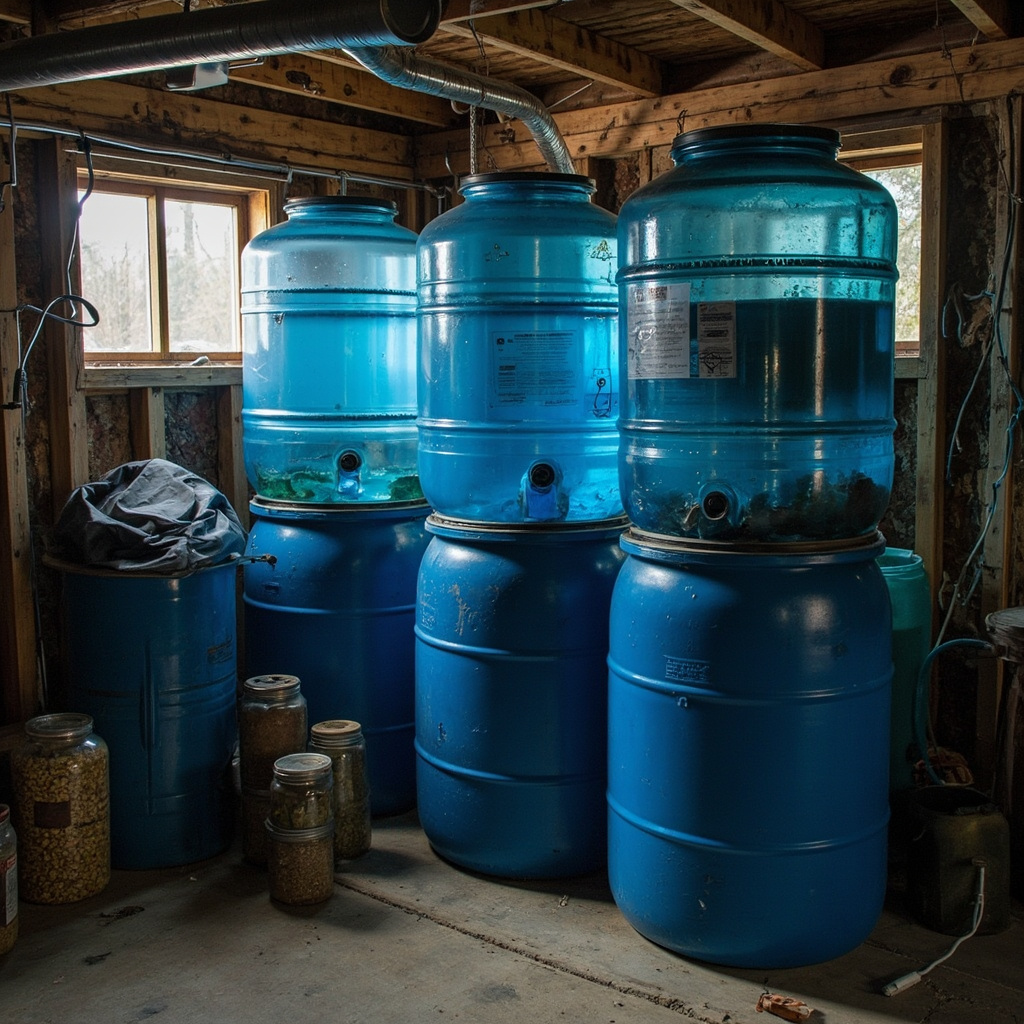
For households with outdoor space or a basement, a 55-gallon water barrel is the gold standard for long-term water storage. A single barrel holds enough water to cover the one-gallon-per-day minimum for a family of four for nearly two weeks.
These heavy-duty barrels are made from food-grade HDPE, are UV-resistant, and are designed to last for years. They come with a bung wrench for sealing the caps and are compatible with barrel pumps for easy dispensing.
The catch: a 55-gallon barrel weighs about 460 pounds when full. You need to place it where it will live before filling it, ideally on a hard, level surface away from direct sunlight. A basement corner or garage wall is perfect.
Browse 55-gallon water storage barrels on Amazon
You will also need a barrel pump to get water out without tipping the barrel. A simple hand-operated barrel pump costs very little and makes the whole setup practical.
Find a water barrel pump on Amazon
Storage Options by Household Size
This table shows recommended storage approaches based on your household size and how long you want your supply to last.
Ranges reflect the difference between 1 gallon per day (minimum) and 1.5 gallons per day (comfortable). Add extra for pets, infants, and hot climates.
Treating Stored Water
Clean tap water from a municipal supply is already treated with chlorine. If you fill your containers from a treated municipal source, that water is generally safe to store as-is. But there are important steps to take to keep it safe over time.
Preparing Containers Before Filling
Always sanitize your containers before filling them with water for storage, even if they are new.
Here is how:
- Wash the container with dish soap and hot water. Rinse thoroughly.
- Make a sanitizing solution by mixing 1 teaspoon of unscented liquid chlorine bleach (at 5 to 9 percent sodium hypochlorite concentration) with one quart of water.
- Pour the solution into the container, seal it, and shake well so it contacts all interior surfaces.
- Let it sit for 30 seconds, then drain. Do not rinse.
- Fill immediately with your water source.
Using Water Preserver Concentrate
For long-term storage, many preparedness experts recommend adding a preservative to extend the safe storage period of your water. Water Preserver Concentrate is designed specifically for this purpose. A single treatment extends the storage life of tap water to 5 years instead of the standard 6 to 12 months.
Water Preserver Concentrate is added at the time of filling. It is safe, tasteless, and approved for drinking water. If you are filling 55-gallon barrels and do not want to rotate them frequently, this is a very practical addition.
Check Water Preserver Concentrate on Amazon
Treating Well Water or Untreated Sources
If your water comes from a well or other source that is not municipally treated, you should treat it before storing. Use plain unscented chlorine bleach. The standard ratio is 8 drops of bleach per gallon of water (for bleach at 6 percent concentration). Add, stir, and let stand for 30 minutes before sealing.
Purifying Water in an Emergency
If your stored supply runs out or you need to use water from an unknown source, you will need to purify it before drinking.
Boiling is the most reliable method. Bring water to a rolling boil for at least one minute (three minutes if you are above 6,500 feet elevation). Let it cool, then store in a clean covered container.
Water purification tablets are a practical backup when boiling is not possible. Aquatabs are a well-regarded option. They are small, lightweight, inexpensive, and effective against bacteria, viruses, and giardia. They work in 30 minutes and leave minimal taste. Keep a bottle in your emergency kit.
Get Aquatabs purification tablets on Amazon
Filtration removes particulates and many pathogens but does not kill viruses on its own. A quality filter like the Sawyer Squeeze is a compact and highly effective option for filtering water from natural sources. It removes 99.99999 percent of bacteria and 99.9999 percent of protozoa. Pair it with purification tablets for full protection against viruses when using untested water sources.
See the Sawyer Squeeze filter on Amazon
Rotating Your Water Supply
Water does not go “bad” in the same way food does, but it can develop off-flavors and, more importantly, the chlorine treatment that keeps it safe gradually breaks down over time.
The general guidance from FEMA is to replace stored tap water every 6 to 12 months. If you used Water Preserver Concentrate, this extends to 5 years.
Building a Rotation System That Actually Works
Most people fail at water rotation because it requires remembering to do something on a specific schedule. Here are practical systems that make it easier:
Label everything. Write the fill date on every container with a permanent marker. Include the rotation date (6 months out) so you know at a glance what needs to be refreshed.
Rotate on a predictable schedule. Pick two dates per year, such as when daylight saving time begins and ends. On those days, you check your water supply. Drain older containers into your garden, laundry, or toilet, then refill.
First in, first out. When you add new containers, move older ones to the front. This is the same rotation principle used in grocery stores and food storage systems.
Set a phone reminder. Put it on your calendar and set an alert. “Water rotation day” twice a year is not hard to remember with a digital nudge.
What Rotation Actually Looks Like in Practice
For a family using five-gallon jugs: when a container is due for rotation, use that water for something that does not require it to be potable (watering plants, rinsing tools, flushing toilets). Then clean and refill the container immediately. You do not need to do all containers at once. Spreading rotation across the year is fine as long as nothing goes past its date.
For 55-gallon barrels: rotation is more work because of the volume. A barrel pump makes it practical. Connect the pump, drain into a large bucket or garden hose, use the water in your yard or for cleaning, then refill. With Water Preserver Concentrate, you only need to do this every five years, which makes the barrel system far more manageable.
Emergency Water Sources You May Not Have Considered
Your stored supply is your first line of defense. But knowing where else to find water during an extended emergency is equally important.
Your Hot Water Heater
Most homes have a standard tank-style water heater holding 30 to 80 gallons. In an emergency, this is a significant, often overlooked water source.
To access it safely:
- Turn off the power or gas supply to the heater to prevent damage.
- Turn off the cold water inlet valve at the top of the tank.
- Open a hot water tap somewhere in the house to break the vacuum.
- Connect a hose to the drain valve at the bottom of the heater.
- Let the water flow out into containers.
This water has been sitting in the tank, which is not a sterile environment. Run it through a filter or treat it with purification tablets before drinking, especially if the heater is old or has not been drained and flushed in a while.
Do not use this water if your water supply was cut off due to contamination at the source, unless you treat it thoroughly.
Swimming Pool Water
A backyard pool holds thousands of gallons. That sounds like a huge emergency water supply, but there are important limits.
Pool water is treated with chlorine and other chemicals to keep it clean for swimming. These treatments make it generally safe for bathing and hygiene even without purification. However, pool water is not safe to drink without additional treatment.
Problems with drinking untreated pool water:
- Chlorine levels may be too high or use stabilizers like cyanuric acid that do not break down easily
- Algaecides and other pool chemicals can be toxic
- Bacteria and other contaminants can accumulate
If you must drink pool water in an emergency, use a quality filtration system and purification tablets. This will not remove all chemical treatments, so use it as a last resort and in small quantities.
Pool water is excellent for flushing toilets, washing clothes, and other non-drinking uses. Save your clean stored water for drinking and cooking.
Rain Collection
Rainwater is relatively clean when it falls, but it picks up contaminants from roof surfaces, gutters, and collection barrels. In a true emergency, collected rainwater filtered through a quality filter and treated with purification tablets is a viable option in areas that receive regular rainfall.
Check your local regulations before setting up a rain collection system. Some states restrict or regulate rainwater collection.
Neighbors and Community Resources
Disasters activate community. During extended emergencies, municipal water distribution points, National Guard resources, and community water-sharing often become available. Knowing where your nearest community center, fire station, or emergency distribution point is can be lifesaving information.
Water Storage Solutions for Apartments and Small Spaces
Not everyone has a basement or garage. Apartment dwellers have real options, but they require a more thoughtful approach.
Space Constraints Are Real but Manageable
The good news about water storage in small spaces is that even a modest supply makes a significant difference. Six five-gallon jugs stored under a bed, in a closet corner, or beneath a bathroom sink provide 30 gallons. For a single person, that covers 30 days at the survival minimum or about two weeks at a comfortable level.
Think about spaces you are not using:
- Under beds (especially platform beds with no frame)
- The back of deep closets behind shoes and coats
- Under bathroom or kitchen sinks (the space is often large enough for two or three five-gallon containers)
- Above kitchen cabinets if they do not go all the way to the ceiling
- Inside unused luggage or suitcases
- In the corner of a laundry room
Stackable Containers Are Your Best Friend
Five-gallon jugs that stack are specifically designed for small-space storage. A stack of six takes up about 24 inches by 12 inches of floor space and reaches about 36 inches tall. That footprint fits in countless closets and corners.
The Reliance blue five-gallon containers mentioned earlier are well-suited to apartment living. They are compact, durable, and easy to carry to a sink for rotation.
See stackable Reliance 5-gallon water containers on Amazon
The WaterBOB for Apartments
If a storm or emergency is predicted and you live in an apartment, the WaterBOB is one of the fastest ways to add 100 gallons of drinking water with no permanent storage footprint. You fill it when you need it, use it during the emergency, and dispose of it afterward.
Every apartment dweller with a bathtub should own a WaterBOB or similar product. It costs very little, stores flat in a kitchen drawer, and can be the difference between having safe water and not having it.
Weight Considerations for Upper Floors
Water is heavy. A five-gallon container weighs about 42 pounds. A 55-gallon barrel weighs about 460 pounds. Apartment floors are designed to handle furniture and normal loads, but stacking heavy water containers in one spot on an upper floor can be a concern.
As a general guideline, spread your containers across multiple locations rather than putting all of them in one corner. Avoid storing large quantities of water directly over other living spaces if possible. For most apartments, a reasonable supply of five-gallon containers spread across a few locations is completely safe. If you are considering a very large storage solution in an apartment, consult your building manager.
Apartment Water Heaters
Most apartments have individual water heaters or access to a shared system. The same principles apply as in a house. A typical apartment water heater holds 30 to 40 gallons, which is a meaningful emergency source for one or two people.
Building Your Water Storage System Step by Step
Starting can feel overwhelming. Breaking it into steps makes it manageable.
Step 1: Calculate your household’s need. Use 1 gallon per person per day as your minimum. Multiply by 14 for a two-week supply. Include pets and any special circumstances.
Step 2: Start small and build. Begin with a two-week supply. Even six five-gallon containers (30 gallons) is a meaningful start for a small household. You can expand over time.
Step 3: Choose your primary storage solution. Five-gallon jugs for flexibility and apartments. A 55-gallon barrel for larger households with storage space. Both is ideal.
Step 4: Pick up a WaterBOB. It is inexpensive, stores flat, and fills a tub in minutes when you know a disaster is coming. This should be in every household regardless of other storage.
Step 5: Get purification backup. A bottle of Aquatabs and a Sawyer Squeeze filter cost under $60 combined and dramatically extend your ability to find and use water from secondary sources.
Step 6: Label and schedule rotation. Mark every container with its fill date. Set a calendar reminder twice a year to check and refresh your supply.
Step 7: Know your emergency sources. Identify your water heater capacity. Know if you have a pool or access to one. Find your nearest community emergency water distribution point.
Frequently Asked Questions
How long does tap water stay safe in a sealed container? Properly stored tap water in a sealed food-grade container generally stays safe for 6 to 12 months. With Water Preserver Concentrate, this extends to 5 years. The water does not necessarily become dangerous after this time, but the chlorine treatment fades and the risk of contamination increases. Rotating on schedule is the safest approach.
Can I use commercial water bottles for long-term storage? Commercial bottled water is generally labeled with an expiration or best-by date. The water itself does not expire, but the thin plastic can degrade over time and may impart flavors. Commercially bottled water is a fine addition to your supply but is more expensive per gallon than filling your own containers from the tap.
Is it safe to drink water from a hot water heater? Yes, with appropriate precautions. Filter it and treat with purification tablets before drinking, especially if the heater is older. Do not use it if the incoming water was contaminated.
What if my water smells funny from storage? A slight plastic smell is common, especially from newer containers. Airing the water by pouring it between containers a few times can reduce this. If water smells sulfurous or otherwise off, treat it before drinking or discard it and use a fresh supply.
Can I store water in my freezer? Yes. Frozen water takes up the same volume and is perfectly safe. Frozen jugs also help keep a freezer cold longer if you lose power, adding a secondary benefit. Leave some expansion room when filling containers for freezing.
How do I treat water I collected from a stream or river? Use a quality filter first to remove sediment and biological contaminants, then treat with purification tablets or boil. A Sawyer Squeeze filter paired with Aquatabs covers both biological pathogens (filter) and viruses (tablets).
Quick Reference: Water Storage Products
Here is a summary of the products mentioned in this guide with links to check current prices on Amazon.
- Reliance 5-gallon blue water containers (flexible, stackable, great for apartments and rotation)
- WaterBOB bathtub bladder (100-gallon emergency fill, single-use, flat storage)
- Aquatank2 water bladder (multi-use alternative to WaterBOB)
- 55-gallon food-grade water barrel (best for long-term storage with space)
- Water barrel pump (necessary for accessing barrel water)
- Water Preserver Concentrate (extends storage life to 5 years)
- Aquatabs purification tablets (lightweight, fast-acting water treatment)
- Sawyer Squeeze filter (removes 99.99999% of bacteria and protozoa)
The Bottom Line
Water storage does not have to be complicated or expensive. The most important thing is to start. A few five-gallon containers filled from your tap today is infinitely better than nothing. Scale up from there as your budget and space allow.
Follow the one-gallon-per-person-per-day rule as your baseline, aim for 1.5 gallons if you can, target at least two weeks of supply, and rotate every six months. Add a WaterBOB for surge situations and a Sawyer Squeeze plus Aquatabs for purification backup. Know where your emergency water sources are, including your hot water heater and, with appropriate treatment, your swimming pool.
The disasters that leave people scrambling for water are predictable. The preparation is not complicated. Do it now, before the sky turns dark.